10 Digital Skills Worth Learning in 2026
You don't need to become a computer scientist to have valuable digital skills.
The way people work has changed considerably over the last few years. Businesses communicate online, customers discover products through social media, employees work with cloud software, and artificial intelligence is becoming part of everyday tasks.
For someone starting from scratch, this can be both exciting and confusing. There are hundreds of skills you could learn, but you don't need to learn everything.
The better approach is to choose skills that can solve real problems.
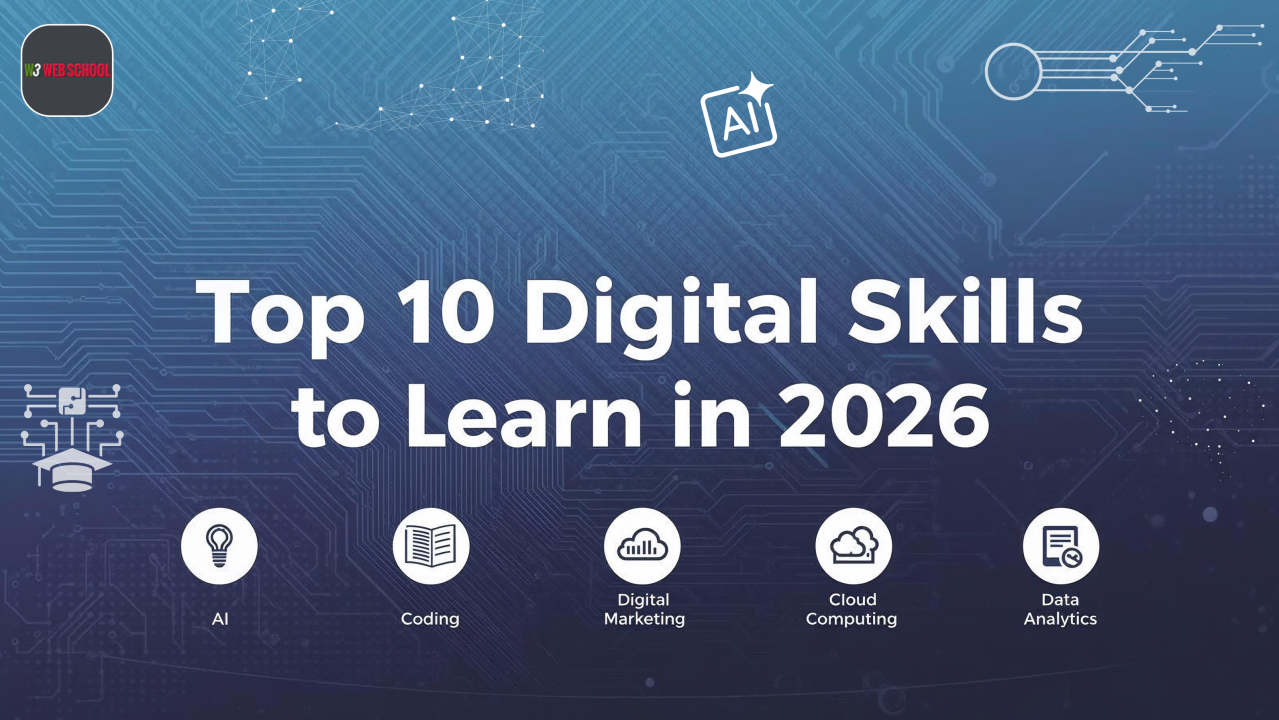
Here are 10 digital skills worth considering in 2026.
1. Using Artificial Intelligence
Knowing how to use AI effectively is becoming a useful digital skill in its own right.
You don't have to build an AI model or become a machine-learning engineer.
You can start by learning how to:
- Write clear prompts
- Give AI useful context
- Check AI-generated information
- Use AI for research and brainstorming
- Automate repetitive tasks
- Understand the limitations of AI
Someone who knows how to use AI responsibly can potentially complete certain tasks faster than someone who doesn't.
The important word is responsibly. AI should be treated as an assistant, not an unquestionable source of truth.
2. Digital Marketing
A great product isn't very useful if nobody knows it exists.
Digital marketing involves using online channels to reach potential customers. This can include search engines, social media, email, websites, online advertising, and content.
A beginner can start by learning:
- Social media marketing
- Search engine optimization
- Content marketing
- Email marketing
- Basic advertising
- Audience research
- Analytics
You don't need a huge company to benefit from these skills.
A small business owner who understands how to attract customers online already has a valuable advantage.
3. Website Development
Websites remain an important part of the digital economy.
You don't necessarily need to become an advanced developer immediately.
Start with the basics:
HTML helps structure webpages.
CSS controls their appearance.
JavaScript adds interactive behavior.
Once you understand these foundations, you can move into frameworks, databases, APIs, and more advanced development.
Even if you eventually use website builders or AI coding tools, understanding the fundamentals makes it easier to know what you're actually working with.
4. Graphic Design
Every business needs visual content.
Logos, social media posts, advertisements, presentations, thumbnails, flyers, and other graphics all require some understanding of design.
You don't have to become a professional designer to benefit from learning the basics.
Start with:
- Typography
- Layout
- Spacing
- Color
- Visual hierarchy
- Image selection
- Branding
Tools such as Canva have also made basic design much more accessible to beginners.
The software matters, but good design principles matter even more.
5. Video Editing
Video has become an important communication format across social media, education, advertising, and business.
Learning basic video editing can therefore be useful even if you have no intention of becoming a professional filmmaker.
Start by learning how to:
- Cut unnecessary footage
- Add captions
- Improve audio
- Add simple transitions
- Arrange clips
- Create short-form videos
- Export videos for different platforms
You can begin with a smartphone and a simple editing application.
You don't need expensive equipment to learn the fundamentals.
6. Cybersecurity Awareness
You don't need to become a cybersecurity professional to learn cybersecurity.
Basic security knowledge is valuable for almost everyone who uses the internet.
Learn how to:
- Create strong, unique passwords
- Use multi-factor authentication
- Recognize phishing attempts
- Protect your accounts
- Keep software updated
- Avoid suspicious downloads
- Identify common online scams
For businesses, the importance becomes even greater because one compromised account can potentially affect customers, employees, and company data.
Cybersecurity isn't only an IT department's responsibility anymore.
7. Data Literacy
Modern businesses generate enormous amounts of information.
Understanding data doesn't necessarily mean becoming a professional data scientist.
At a basic level, data literacy means being able to read information, identify patterns, understand simple statistics, and make reasonable conclusions from data.
Learning tools such as spreadsheets can be a good starting point.
You can learn:
- Formulas
- Sorting and filtering
- Charts
- Basic analysis
- Data organization
- Simple reporting
These skills are useful across many different careers.
8. Communication and Content Creation
Technology hasn't eliminated the need for good communication.
If anything, it has created more opportunities to communicate.
Businesses need people who can create useful blog posts, social media content, newsletters, presentations, videos, and other forms of digital communication.
Learning how to communicate clearly can make your other technical skills more valuable.
Even if AI helps you create a first draft, humans still need to decide what is worth saying and whether it makes sense.
9. Cloud and Online Collaboration Tools
Many organizations now depend on online services to store information and collaborate.
Understanding basic cloud tools can make working with remote teams much easier.
You might encounter:
- Cloud storage
- Online documents
- Project-management platforms
- Shared calendars
- Team communication tools
- Online meeting platforms
You don't need to understand the engineering behind cloud computing to use these services effectively.
However, understanding basic concepts such as cloud storage, permissions, synchronization, and account security is useful.
10. Problem-Solving With Technology
This may be the most underrated skill on the list.
Technology changes constantly. A specific application you learn today may look completely different next year.
If you only memorize steps, you can quickly become stuck when something changes.
Instead, develop the ability to investigate problems.
For example:
Your website isn't loading.
Rather than immediately giving up, you can learn to ask:
- Is the internet connection working?
- Is the domain active?
- Is the server running?
- Is there an error message?
- Did something recently change?
- Can I reproduce the problem?
- Can I find reliable documentation about the error?
That way of thinking applies to almost every area of technology.
Which Skill Should You Learn First?
The answer depends on your goals.
If you're a student
Start with:
- AI literacy
- Research skills
- Communication
- Basic data skills
- Productivity tools
If you want to start an online business
Consider:
- Digital marketing
- Website development
- Graphic design
- Content creation
- AI tools
If you want to become a developer
Start with:
- Programming fundamentals
- Problem-solving
- Web development
- Databases
- Version control
If you're a content creator
Focus on:
- Video editing
- Graphic design
- Social media
- AI tools
- Communication
If you're looking for general career development
A combination of AI literacy, communication, data skills, cybersecurity awareness, and digital productivity is a good foundation.
Don't Try to Learn Everything at Once
One of the biggest mistakes beginners make is jumping between too many skills.
They spend a week learning Python, another week learning graphic design, then move to digital marketing before finishing anything.
After several months, they know a little about everything but aren't particularly useful at any one thing.
A better approach is to choose one primary skill and spend several weeks or months developing it.
You can then add complementary skills.
For example:
Web development + AI + digital marketing
can be a powerful combination for someone interested in building digital products and businesses.
Likewise:
Graphic design + video editing + social media marketing
can be useful for someone interested in content creation.
The goal isn't to collect certificates.
The goal is to become capable of solving real problems.
Final Thoughts
Digital skills aren't reserved for people who grew up around computers.
Most of them can be learned gradually through practice.
Start with something that interests you, build small projects, make mistakes, and keep improving.
The technology will continue changing. New software will appear, existing platforms will disappear, and AI will continue influencing how people work.
But the ability to learn, adapt, communicate, solve problems, and use technology effectively will remain valuable.
Choose one skill.
Learn it properly.
Then build something with it.
This article is part of Alvonbot.com's Digital Skills series.

Leave a comment
Your email address will not be published. Required fields are marked *