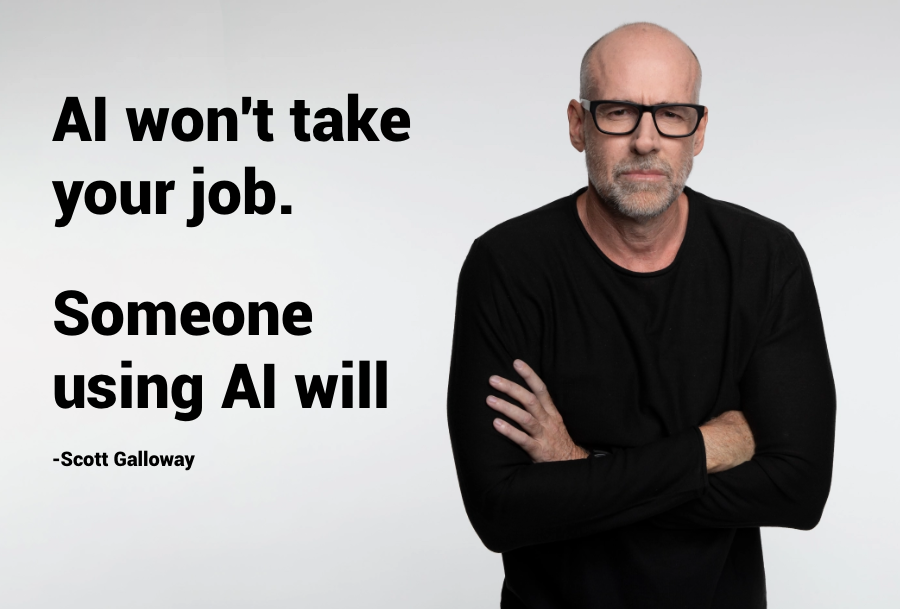
AI Is Not Taking Your Job—But Someone Using AI Might
Artificial intelligence has become one of those topics that can start an argument almost anywhere.
Mention AI at a family gathering and someone will probably say, “These robots will soon take all our jobs.”
Someone else will say, “AI is overrated.”
And somewhere in the corner, another person is probably using ChatGPT to write an email they don't want to write themselves.

The truth is somewhere in the middle.
AI is changing the way people work, but the biggest story isn't necessarily that machines are going to replace everyone. The more immediate change is that people who know how to use AI effectively can often work faster and accomplish things that previously required much more time.
So, Is AI Actually Taking Jobs?
AI has already started changing many jobs.
Tasks involving writing, customer support, research, data analysis, image creation, programming and repetitive office work can now be assisted by AI tools.
But there's an important difference between automating a task and replacing an entire job.
For example, a person working in marketing might spend an hour brainstorming ideas for social media posts.
With an AI assistant, that person could generate dozens of ideas in a few minutes.
The marketer hasn't necessarily disappeared.
Instead, the boring part of the job has become faster.
And that's one of the most interesting things about AI.
Think of AI as a Very Fast Assistant
One useful way to understand AI is to imagine having an extremely fast assistant sitting beside you.
You can ask it to:
- Explain a complicated topic.
- Brainstorm business ideas.
- Summarize a long document.
- Write a first draft.
- Generate programming examples.
- Create an outline for an article.
- Analyze information.
- Help you learn something new.
But there's a catch.
Your AI assistant isn't necessarily an expert who is always correct.
It can make mistakes.
That's why you still need your own judgment.
The Person Giving the Instructions Still Matters
Imagine giving two people the same powerful camera.
One person knows how to compose photographs.
The other simply points the camera at everything and presses the button.
They have the same equipment, but the results will probably be very different.
AI works in a similar way.
Two people can use the same AI tool and get completely different results.
The person who understands how to explain what they want, check the answer and improve the result will usually get more value from the technology.
That's why learning how to communicate with AI is becoming an increasingly useful skill.
You Don't Need to Be a Programmer
This is where things get interesting.
You don't need to know Python, JavaScript or another programming language to start benefiting from AI.
A student can use AI to understand a difficult lesson.
A business owner can use it to brainstorm marketing ideas.
A designer can use AI to explore concepts.
A developer can use it to troubleshoot code.
A content creator can use it to develop ideas.
A job seeker can use it to improve a CV.
The important thing is knowing when AI is useful and when you should rely on your own knowledge.
But Don't Believe Everything AI Says
Here's a mistake beginners often make.
They ask an AI a question, receive a confident-looking answer and immediately assume it's correct.
That's risky.
AI systems can sometimes produce incorrect information, misunderstand a question or present outdated information as if it were certain.
For important subjects, always verify the information using reliable sources.
Think of AI as a helpful assistant—not an all-knowing oracle.
The Real Advantage May Be Speed
Imagine two people are given the same assignment.
One spends three hours researching, organizing ideas and creating a first draft.
The other uses AI to help brainstorm, organize information and create a starting point, then spends the same time checking and improving the work.
The second person may be able to spend more time thinking about quality instead of starting from an empty page.
That's where AI becomes genuinely powerful.
It's not necessarily about doing less work.
It's about spending more of your time on the work that actually requires human judgment.

What Should You Learn?
If you're new to artificial intelligence, don't feel like you need to learn everything at once.
Start with simple skills:
Learn how to write good prompts.
Tell the AI exactly what you want, who the audience is and what kind of result you're looking for.
Learn how to check AI-generated information.
Don't blindly trust every answer.
Learn how to edit AI-generated content.
AI can give you a starting point, but your personality and judgment can make the final result much better.
Learn how AI fits into your own work.
Instead of asking, “What can AI do?”, ask:
«“What part of my work takes too much time that AI could help me with?”»
That's a much better question.
The Future Belongs to People Who Adapt
Every major technology has created fear.
Machines changed factories.
Computers changed offices.
The internet changed communication and business.
Smartphones changed how we access information.
AI is now creating another major shift.
Nobody knows exactly what the job market will look like years from now. But one thing is already clear: knowing how to work with new technology can be an advantage.
So, will AI take some jobs?
Probably.
Will it create new opportunities too?
Almost certainly.
But perhaps the bigger question isn't:
“Will AI take my job?”
Maybe it's:
“What can I learn to do with AI before someone else does?”
And that is a much more exciting question.

Leave a comment
Your email address will not be published. Required fields are marked *