**The Big Shift: From Chatbots to Agentic AI**
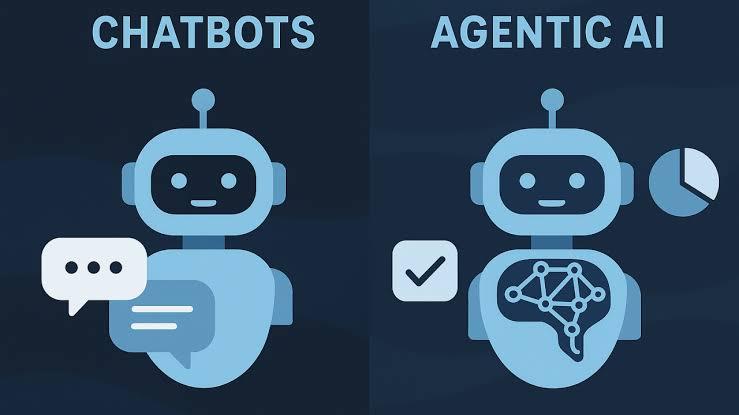
In late 2022 and 2023, the world met artificial intelligence mainly through chatbots. You typed a question, received a polished paragraph, and the interaction ended. That era is rapidly giving way to something more powerful and more useful: **agentic AI**.
Agentic systems do not merely answer. They plan, act, use tools, maintain memory across long sessions, recover from mistakes, and complete multi-step work with far less hand-holding. This is the defining shift of 2025–2026.
### What Chatbots Actually Were
Classic chatbots (and early large language models used in chat interfaces) operated in a simple loop:
1. Receive a prompt.
2. Generate a response.
3. Wait for the next prompt.
They excelled at summarization, drafting, explanation, and brainstorming. They failed at anything that required sustained action in the real (or digital) world: booking a multi-city trip while checking constraints, debugging a large codebase across files, running a research literature review that includes downloading papers and extracting data, or managing a multi-day project with changing requirements.
### What Agentic AI Means
An AI agent is a system that can:
- Break a high-level goal into sub-tasks
- Choose and call external tools (browsers, code interpreters, APIs, databases, email, calendars, computer control)
- Observe the results of those actions
- Update its plan
- Persist relevant context over hours or days
- Decide when it needs human input versus when it can continue
In short, the model moves from “talking about work” to “doing work.”
Key enabling technologies that matured in 2025–2026 include:
- Reliable tool-calling and function calling
- Long context windows (often 1 million tokens or more)
- Better reasoning and planning techniques (including multi-hypothesis “Deep Think”-style methods)
- Computer-use capabilities (the model can see a screen, click, type, and navigate applications)
- Shared protocols such as the Model Context Protocol (MCP) that standardize how models connect to tools and data
- Improved memory and state management across sessions
### Evidence the Shift Is Real
Performance on practical benchmarks tells the story clearly. On OSWorld (a suite of everyday computer tasks), agent success rates climbed from roughly 12% to about 66% in two years. Coding agents now routinely handle large repositories, write tests, debug, and open pull requests. Major technology companies report that a large share of new code is AI-generated under human review — in some cases exceeding 50–75%.
Enterprise deployments have moved beyond simple copilots. Agents now draft full documents and presentations, manage multi-step research workflows, automate software testing pipelines, and act as persistent teammates inside tools such as Slack or project management systems.
### Real-World Patterns Emerging in 2026
- **Software engineering**: Terminal-based and IDE-integrated agents plan, write, test, and iterate across entire projects.
- **Knowledge work**: Agents can be given a goal such as “prepare a competitive analysis on X including financials and recent news,” then gather sources, extract data, synthesize findings, and produce a structured report.
- **Scientific research**: Systems help generate hypotheses, write experimental code, search literature, and even propose solutions to open mathematical or physical problems.
- **Personal and team productivity**: Voice-native agents and computer-using agents handle scheduling, email triage, form filling, and multi-application workflows.
### Important Limitations (Still)
Agentic AI is powerful but imperfect. Current systems can still:
- Get stuck in loops or pursue inefficient paths
- Hallucinate tool outputs or misinterpret intermediate results
- Struggle with highly novel or poorly specified goals
- Require careful permissioning and oversight, especially when they control computers or external systems
Reliability improves with better scaffolding (clear goals, tool constraints, verification steps, and human-in-the-loop checkpoints). The best results today come from treating agents as capable junior collaborators rather than fully autonomous employees.
### How to Work with Agentic AI Today
1. Give clear, high-level goals and success criteria instead of micro-managing every step.
2. Provide the right tools and data access (and restrict what is not needed).
3. Review intermediate outputs and correct course early.
4. Use structured formats (checklists, evaluation criteria, acceptance tests) so the agent can self-check.
5. Start with well-bounded tasks before expanding to open-ended projects.
### Looking Ahead
The trajectory is clear. Chat interfaces will remain useful for quick questions and brainstorming, but the primary way most people interact with advanced AI is shifting toward goal-oriented agents. As memory, tool use, multimodality, and reliability continue to improve, these systems will increasingly function as persistent collaborators that track context across weeks and months.
The practical question is no longer “Can AI write a good paragraph?” It is “What multi-step work can I productively hand to an agent, and how do I set it up for success?”
That is the big shift of 2026.

Leave a comment
Your email address will not be published. Required fields are marked *